


















































































The 2026 Henley Passport Index was officially released today, Tuesday, 13 January 2026, revealing a world increasingly divided by “mobility inequality.” While Asian and European nations continue to consolidate their grip on the top spots, the United Kingdom and the United States are grappling with their steepest ranking declines in over a decade.
Singapore has once again emerged as the sole leader of the pack, with its citizens enjoying visa-free or visa-on-arrival access to a record 192 destinations worldwide.
Asia continues to dominate the pinnacle of global travel, with Japan and South Korea securing the second spot. Notably, the United Arab Emirates (UAE) has completed its historic ascent into the Top 5, adding 149 destinations to its tally since 2006.
| Rank | Country | Visa-Free Destinations |
| 1st | Singapore | 192 |
| 2nd | Japan, South Korea | 188 |
| 3rd | Denmark, Luxembourg, Spain, Sweden, Switzerland | 186 |
| 4th | Austria, Belgium, Finland, France, Germany, Greece, Ireland, Italy, Netherlands, Norway | 185 |
| 5th | UAE, Hungary, Portugal, Slovakia, Slovenia | 184 |
| 7th | United Kingdom, Australia, Latvia, Liechtenstein | 182 |
| 10th | United States, (Re-entered Top 10) | 179 |
The “Anglo-Saxon” Slide: The UK and US, which jointly held 1st place in 2014, have seen their influence wane. The UK recorded its worst year-on-year loss in 2026, dropping to 7th place, while the US barely clawed back into the Top 10 after briefly falling out in late 2025.
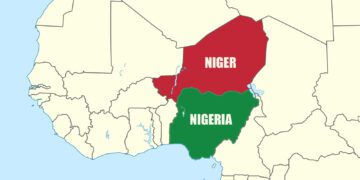
For Nigeria, the 2026 index tells a story of stagnation in a rapidly moving world. The Nigerian passport currently sits at 95th position globally.
Currently, Nigerians can access only 45 countries visa-free or with a visa-on-arrival. Within West Africa, Nigeria continues to trail behind neighbors like The Gambia (68th), Ghana (71st), and Sierra Leone (73rd).
Experts suggest that the high volume of asylum requests and overstay rates in the West remains the primary hurdle for Nigeria in negotiating more visa-waiver agreements.
The 2026 report highlights a “stark and widening” gap between the most and least mobile citizens. At the bottom of the list, Afghanistan remains at 101st place with access to just 24 destinations—a 168-destination gap compared to Singapore.
Dr. Christian Kaelin, Chairman of Henley & Partners, noted:
“Global mobility is no longer just about tourism; it is about economic optionality. In 2026, the ‘passport divide’ is the new digital divide. Those with restricted movement are effectively locked out of the globalized economy.”
Notably, the EU’s new digital visa system has slightly slowed down the “real-time” travel scores for some non-EU nations as technical protocols are finalized.
As the UAE’s success is being used as a blueprint for other Gulf nations like Saudi Arabia and Qatar, both of which saw significant jumps this year.
While global rankings are slow to reflect it, intra-African mobility is at an all-time high, with more African nations adopting “Visa-on-arrival for Africans” policies.